
A Strategic Bond,
A Shared Future.
Saudi Arabia’s engagement with Africa did not begin with a summit. It runs through six decades of embassies opened, development finance committed, humanitarian response mounted and quiet mediation offered — built on proximity, on shared faith and history, and on a Red Sea that has always worked as a corridor rather than a border.
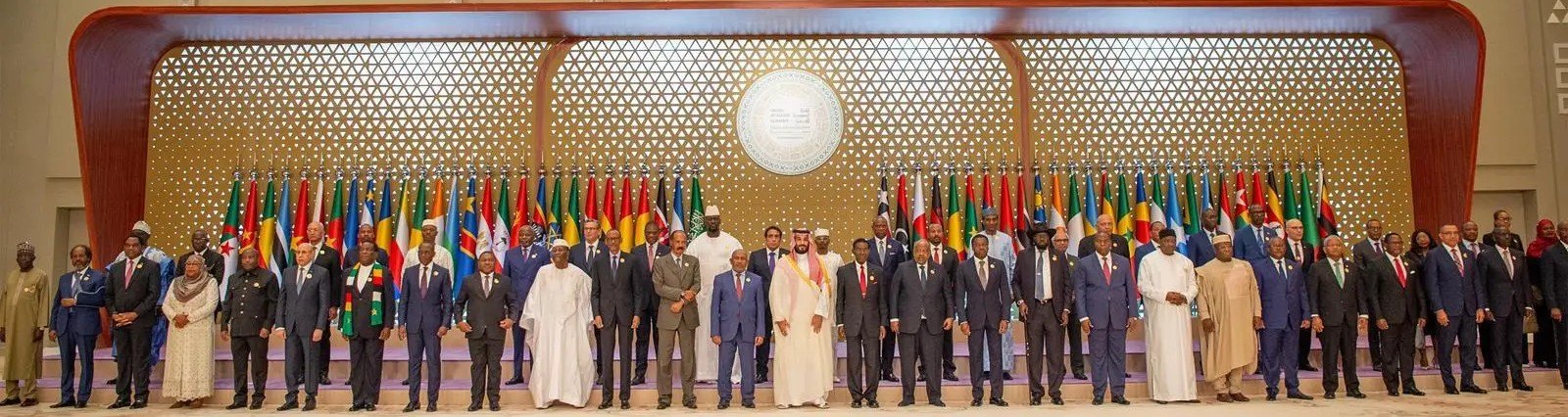
What changed in 2023 was the framing. The Kingdom set out a view of the continent as a strategic partner rather than a set of separate files — delegations from more than fifty countries in one room, and a reference document, the Riyadh Declaration, that marks the beginning of a new era in the relationship.
SPDC KSA exists to do the work that framing implies — helping Saudi institutions turn that intent into partnerships designed together, delivered in the field, and measured honestly.
Swipe to see the full line →
First Saudi–African Summit, King Abdulaziz International Conference Centre, Riyadh, 10 November 2023.
A Red Sea corridor, not a border. The Kingdom’s nearest neighbours across the water are African.
Six decades of diplomatic, development, trade, humanitarian and peace-building engagement — long before it had a name.
The Riyadh Declaration, 2023. The agreed reference point for the era that follows, and the framework our work sits inside.
Network reach. These figures describe established professional and institutional relationships reachable through the wider SPDC partner network. They are not presented as SPDC KSA employees, nor as organisations under contract to SPDC KSA. Engagement-specific capacity is confirmed at the point of scoping.
Five domains, all of them running since the 1960s.
Sustained Saudi engagement with independent Africa began in the 1960s and has been layered ever since — resident diplomatic missions first, then development finance, then humanitarian delivery, then commerce, with peace mediation running alongside. Each domain has its own institutions, its own dated record, and its own evidence base. That accumulated history — not the 2023 summit alone — is what SPDC KSA builds on.
DiplomaticSince the 1960s25+African capitals with a resident Saudi diplomatic mission
The foundation is formal representation. As African states gained independence through the 1960s, Saudi Arabia opened resident missions rather than working the continent from a distance, and King Faisal's tours put the relationships on a head-of-state footing. Today Saudi embassies operate in more than twenty-five African capitals — one of the largest resident diplomatic footprints any Gulf state maintains on the continent.
- 1966 · 1972King Faisal's African tours — Sudan, Morocco, Guinea, Mali and Tunisia among the stops — open sustained Arab–African political coordination at head-of-state level.
- 1960s–70sResident embassies are established across newly independent Africa, from Khartoum and Nouakchott to Dakar, Bamako, Conakry and Abuja.
- TodayMissions across North, West, Central, East and Southern Africa — including Addis Ababa, seat of the African Union, and an economic division in Yaoundé.
- 2023Riyadh convenes the first Saudi–African Summit at head-of-state level and issues the Riyadh Declaration.
DevelopmentSince the 1960s266SFD projects in 41 Sub-Saharan countries, 1975–2016, worth SAR 15.47bn — the most defensible historical baseline
Bilateral Saudi support for African institutions predates any dedicated fund — the money moved through direct contributions before there was machinery to carry it. The oil boom of 1973 changed the scale and produced the three institutions that still finance African development today. This is the domain with a genuine project-level record rather than announced intent.
- 1960sDirect Saudi contributions support Islamic and civic institutions in West Africa, including construction of the Lagos Central Mosque — bilateral support before any development institution existed.
- 1973 · 1975BADEA is created by Arab OPEC members and opens with $231 million of capital; by February 1977 it has disbursed $143 million to 20 African projects.
- 1974 · 1975The Saudi Fund for Development is established by royal decree and begins lending; the Islamic Development Bank opens in Jeddah.
- 1975–2016SFD finances 266 projects across 41 Sub-Saharan countries — social infrastructure 64, agriculture 43, energy 21, industry and mining 12.
- 2023SFD signs 14 loan agreements with 12 African countries worth more than $580 million, covering health, water, education, roads, dams and power.
Investment & TradeSince the 1960s47Saudi companies already operating in Africa, on SAR 49.5bn invested over the past decade
Commerce is the oldest link and the slowest to institutionalise. Red Sea maritime trade connected western Arabia to the Horn long before either side had a trade policy, but it stayed modest until the oil boom gave it capital and Vision 2030 gave it direction. The corporate layer is recent, and the 2030 targets sit on top of a real but younger base.
- 1960sRed Sea maritime and commercial links carry the relationship, framed as part of Arab and Muslim affairs rather than continent-wide economic policy.
- 1973The oil boom transforms the scale of Arab–African finance; the OPEC Special Fund opens with $800 million, more than half reportedly from Saudi Arabia and Iran.
- 2000sSaudi corporates including SABIC establish offices and subsidiaries in Morocco, Tunisia and South Africa; investors begin exploring agriculture and food security.
- 2019–23Saudi non-oil exports to Africa exceed SAR 128 billion — chemicals and polymers above SAR 83 billion, construction materials above SAR 10 billion.
- To 2030Targets set at SAR 96 billion (over $25 billion) in investment, $10 billion in export financing, $5 billion in development funding.
HumanitarianSince the 1960s113Beneficiary countries in the KSrelief project database, across more than 4,300 projects
Saudi social and relief engagement in Africa began with education and outreach networks in the 1960s and ran for five decades through many ministries and charities without a single ledger. Consolidating it under one body in 2015 is what made it auditable — and the figures below are an operator's own open project database, not an estimate from a donor report.
- 1961 · 1965The Islamic University of Medina opens to students from abroad; a Muslim World League mission travels to Sudan, Benin, Niger, Mali, Senegal, Mauritania and Nigeria.
- 2015The King Salman Humanitarian Aid and Relief Centre is established in May as the Kingdom's single humanitarian platform, with published country-level accounts.
- OngoingSomalia: roughly $257 million across 167 projects — $131.3m food security, $40.4m health, $28.8m water and sanitation, $15.8m education.
- 2023Saudi Arabia announces $100 million in emergency humanitarian aid for Sudan following the outbreak of war.
Peace building & mediationSince the 1960s3African conflicts brought to signed agreement on Saudi soil — Chad–Sudan, Ethiopia–Eritrea, and the Sudan talks
This is the domain money cannot buy, and the one that distinguishes Saudi Arabia from every other external partner working on the continent. From the multilateral channels built in the 1960s to three signed agreements in the last two decades, Riyadh and Jeddah have repeatedly served as the room where African parties agreed to stop fighting — trusted by both sides, accepted by the UN, and asked back.
- 1969The Organisation of Islamic Cooperation is created and its General Secretariat seated in Jeddah, giving Saudi Arabia a standing multilateral channel among member states, most of them African.
- 2007The Riyadh Agreement. Presidents Omar al-Bashir and Idriss Déby sign a Saudi-brokered reconciliation deal committing Sudan and Chad to respect each other's territorial integrity, stop sheltering each other's opposition forces, and work with the African Union and UN to end the conflict in Darfur and eastern Chad.
- 2018The Jeddah Agreement. Ethiopia and Eritrea sign the Agreement on Peace, Friendship and Comprehensive Cooperation on 16 September under Saudi auspices, formally ending the state of war. The UN Security Council welcomed the agreement and expressed appreciation for Saudi Arabia's facilitation.
- 2023The Jeddah talks on Sudan. Saudi Arabia hosts and co-facilitates negotiations between Sudan's warring parties, pairing the mediation track with a $100 million humanitarian package.
A commitment is not a disbursement, and a disbursement is not an outcome.
Public reporting on Saudi–African cooperation mixes these seven stages freely, and the totals move depending on whether "Africa" means the continent or only Sub-Saharan Africa, and whether "support" includes grants, concessional loans, capital subscriptions and multilateral contributions together. SPDC KSA separates the stages before it advises anyone. Summit figures are reliable indicators of strategic intent; project-level databases are the evidence of what was actually built. We do not present the first as the second.
Tell us where you want to be on the continent.
Send us the problem you are trying to solve. We reply within three working days.
Request a service